

What Risk and Compliance Challenges Do Financial Institutions Face?
The financial services industry, a $26 trillion behemoth [source: Statista, Global Financial Services Market Size 2023], thrives on trust and security. Financial institutions (FIs) face the critical task of protecting vast amounts of sensitive data and managing the seamless transfer of funds, all while navigating the intricate compliance challenges inherent to the industry.
However, navigating the ever-changing landscape of risk and compliance challenges poses a constant struggle.
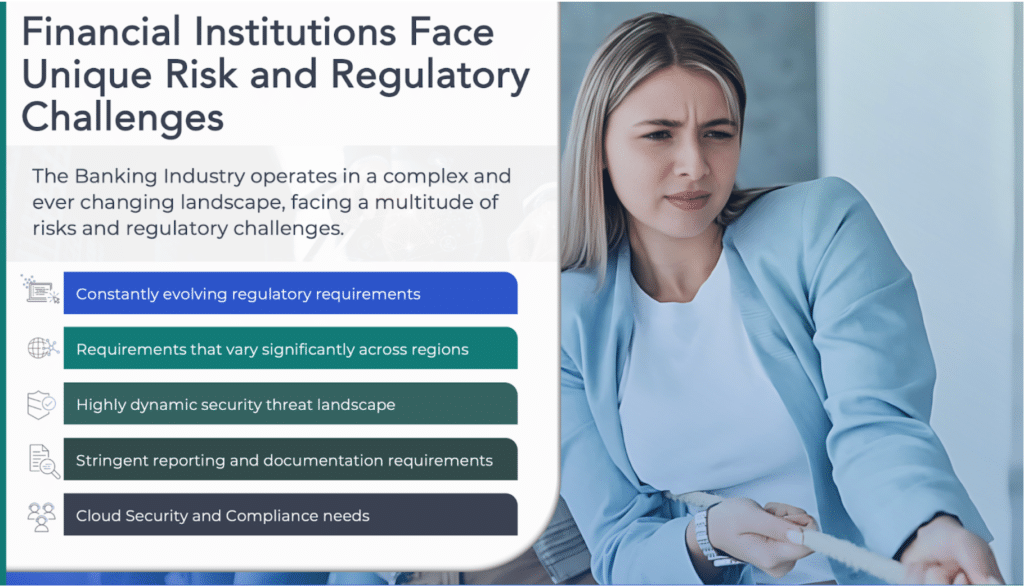
1. Constantly Evolving Regulatory Requirements: A 2023 study by Accenture found that compliance costs have increased by 60% for retail and corporate banks compared to pre-financial crisis levels [source: Riskonnect, Financial Compliance: The Top 5 Compliance Challenges]. Keeping up with the regulatory flux requires constant vigilance. For instance, the introduction of Open Banking regulations in Europe (PSD2) mandated stricter data security measures for FIs, along with specific reporting requirements on implemented changes and customer notifications.
2. Risk Reporting Requirements That Vary Significantly Across Regions: The global nature of finance presents another challenge. A 2022 report by the Federal Reserve Bank of New York estimates that cross-border financial transactions account for over 10% of global GDP [source: Federal Reserve Bank of New York, Cross-Border Finance: Recent Developments and Ongoing Issues]. An FI with a presence in the United States and Singapore, for example, would need to comply with the Bank Secrecy Act (BSA) and its stringent Anti-Money Laundering (AML) reporting requirements in the US, while also adhering to Singapore’s stricter Know Your Customer (KYC) regulations and their specific reporting mandates.
3. Highly Dynamic Security Threat Landscape: Cybersecurity threats are a constant thorn in the side of FIs. According to a PwC report, the financial services industry witnessed a 78% increase in cyberattacks in 2022 compared to 2021 [source: PwC, Global Economic Crime and Fraud Survey 2023]. Effective incident response plans are essential, alongside robust reporting procedures. FIs need to report security breaches promptly to regulatory authorities, often with specific details about the nature of the breach, the data potentially compromised (including the number of customers affected), the financial losses incurred, and the steps taken to rectify the situation.
4. Stringent Reporting and Documentation Requirements: Regulatory bodies often require FIs to maintain detailed records of vast amounts of data. A study by IBM found that the financial services industry generates more data than any other sector [source: IBM, The Digital Universe in 2020]. This data can include customer transactions (estimated at over 1 trillion daily ACH payments in the US alone [source: NACHA, 2022 NACHA Payments Data]), risk assessments, and internal controls. FIs need efficient data management systems to ensure accurate and timely reporting. This might include customer due diligence reports, ongoing monitoring reports to identify suspicious activity, and reports on implemented sanctions screening measures.
5. Cloud Security and Compliance Challenges and Needs: Cloud computing offers FIs flexibility and scalability, but introduces new considerations. A study by Gartner predicts that by 2025, 95% of financial institutions will move a portion of their core banking systems to the cloud [source: Gartner, Press Release, Gartner Says 95% of Financial Services Firms Will Move to Cloud by 2025]. However, data security in the cloud environment needs to be robust. FIs are responsible for ensuring they understand where their data is stored and how it’s protected by their cloud service providers (CSPs). Reporting on these measures and any potential cloud-related security risks becomes critical.
By effectively managing these risks and adhering to compliance challenges mandates, FIs can build trust with their customers and regulators. Investing in automation tools, fostering a culture of compliance challenges, and maintaining a proactive approach to security are all essential steps in navigating today’s complex financial landscape.
For more information, visit “Fintech CTO Training” or contact us.

